Everyday family life usually does not become stressful because of one big problem. More often, it is the tiny repeat moments that wear parents down: missing shoes, rushed breakfasts, homework battles, messy toys, bedtime negotiations, and the emotional surprises that seem to arrive right when dinner is almost ready.
The good news is that family life does not need to be perfect to feel easier. Small systems, warm boundaries, and realistic expectations can make home feel calmer for both children and parents. These parenting tips are designed for real households, including busy working parents, stay-at-home parents, single parents, co-parents, families with grandparents nearby, and moms doing their best across packed school weeks.
Before jumping into the 15 tips, remember this: children do better when they know what to expect and feel connected to the adults guiding them. The CDC’s positive parenting guidance emphasizes encouragement, clear communication, and consistent limits. Those same ideas show up again and again in the habits below.
| Daily friction point | Simple shift | Why it helps |
|---|---|---|
| Morning rush | Prepare the night before | Reduces decisions when everyone is tired |
| Meltdowns | Connect before correcting | Helps kids calm down enough to listen |
| Messy rooms | Use fewer, clearer storage spots | Makes cleanup easier to repeat |
| Screen battles | Create predictable media rules | Reduces daily negotiation |
| Parent burnout | Plan small resets | Keeps stress from becoming the family climate |
Start with routines that support your real life
A family routine should not feel like a strict military schedule. It should feel like a rhythm everyone can return to, even after a hard day. The goal is not to control every minute. The goal is to make the next right step obvious.
1. Create a morning launchpad
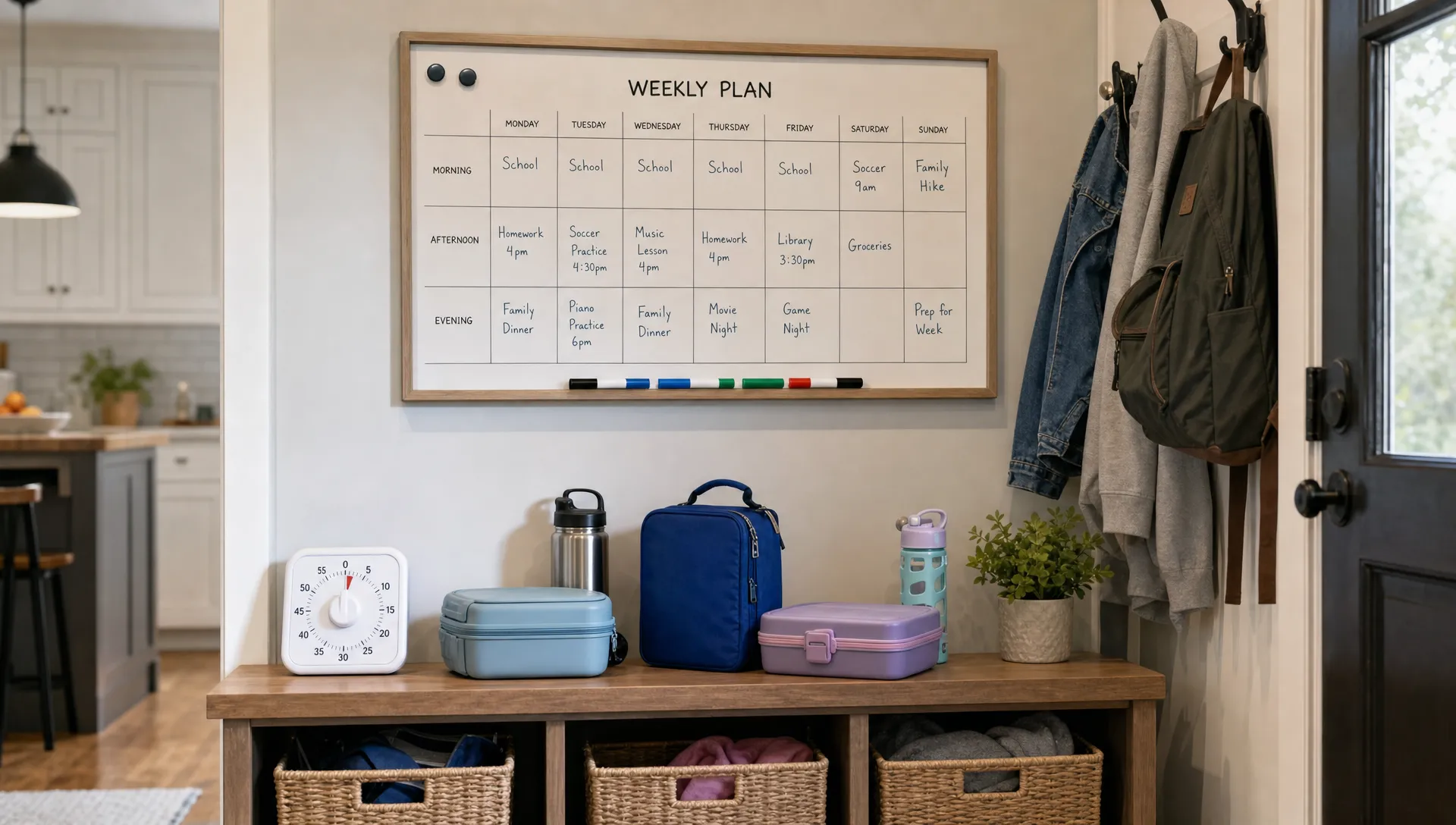
Choose one place near the door, hallway, mudroom, or dining area where everyday essentials live. Backpacks, school IDs, shoes, umbrellas, water bottles, and lunch bags should have a predictable home. If your mornings involve school transport, traffic, or a long commute, this one habit can save a surprising amount of stress.
For younger kids, use picture labels or simple baskets. For older kids, let them personalize their spot so it feels like ownership, not another parent command. Before bedtime, do a quick launchpad check together. Is the homework packed? Is the uniform ready? Is there a clean water bottle? A five-minute evening reset often prevents a 20-minute morning scramble.
2. Make routines visible
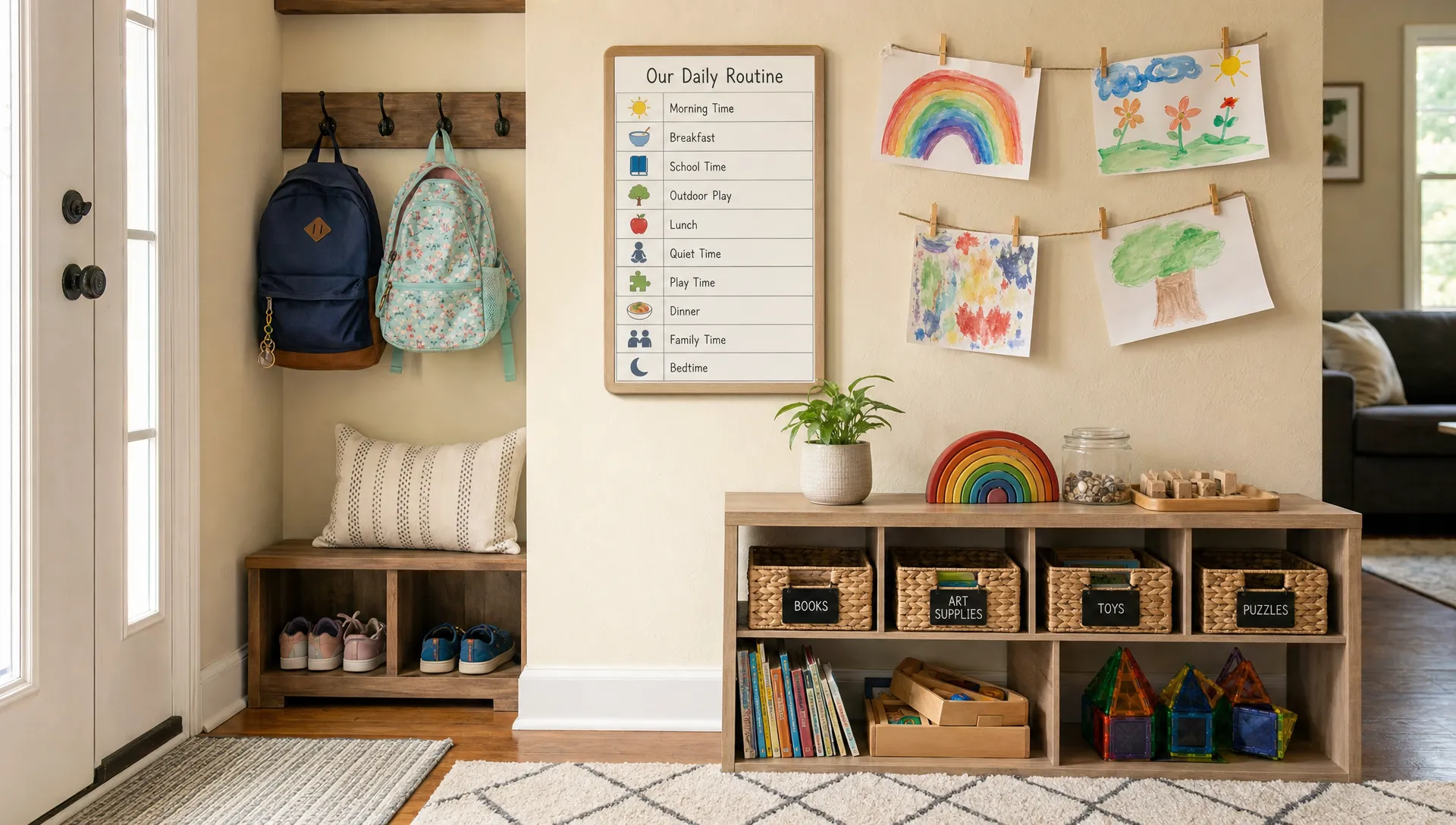
Children often resist repeated instructions because the instructions feel endless. A visible routine turns your voice into a guide instead of a constant alarm. Place a small chart on the fridge, bedroom wall, or closet door with the basic steps for morning, after-school, and bedtime routines.
Keep the routine short. For bedtime, five steps may be enough: bath, pajamas, brush teeth, story, lights out. For mornings, try wake up, get dressed, eat, brush teeth, grab bag. When kids can see what comes next, they rely less on reminders and gain confidence in doing things independently.
This works especially well when you let children mark off each step with a magnet, sticker, or clothespin. The simple act of moving through a routine gives them a sense of progress.
3. Use connection before correction
When a child is upset, the fastest way to cooperation is often not a lecture. It is a moment of connection. This does not mean giving in. It means helping your child feel safe enough to hear you.
Try kneeling to their level, using a calm tone, and naming what you see. You can say: I can see you are angry. I will not let you hit. We can stomp our feet or squeeze a pillow instead. That kind of response gives two messages at the same time: your feelings are allowed, and unsafe behavior is not.
Connection before correction is especially useful during sibling fights, homework frustration, and end-of-day tiredness. Many children act out when they are hungry, overwhelmed, jealous, or unsure how to express disappointment. When you address the feeling and hold the boundary, you teach emotional skills instead of only stopping behavior in the moment.
4. Give directions kids can actually follow
A common parenting trap is giving a long instruction and expecting a child to process all of it at once. Many kids do better with one clear direction at a time.
Instead of saying, hurry up, clean this mess, stop playing, and get ready because we are late, try one specific instruction: Put the blocks in the basket. After that, give the next step. Shorter directions are easier to follow and easier for you to reinforce.
Positive phrasing also helps. Say walk inside instead of stop running. Say use gentle hands instead of do not be rough. Children still need limits, but clear replacement behavior teaches them what to do next.
5. Offer two acceptable choices
Choices help children feel a sense of control, which can reduce power struggles. The secret is offering choices you can truly accept.
For toddlers and preschoolers, try simple options: red cup or blue cup, sandals or sneakers, story first or pajamas first. For school-age kids, choices might sound like: homework before snack or after snack, reading on the couch or at the table, shower now or after dinner.
Avoid offering a choice when there is no real choice. If leaving the house is non-negotiable, do not ask if they want to go. Instead, ask how they want to walk to the car, holding your hand or carrying their small bag.
6. Keep family rules few and repeatable
Too many rules become background noise. A few clear family rules are easier for children to remember and easier for parents to uphold.
Simple rules work best: safe hands, kind words, take care of our things, tell the truth, and help when you can. Repeat these rules often, not only when someone breaks them. You can point out examples during normal family life: You used kind words with your sister. That helped her feel included.
When rules are tied to values, children begin to understand the reason behind them. The goal is not obedience for its own sake. The goal is a family culture where everyone knows how to treat one another.
7. Build mini breaks into transitions
Transitions are hard for many kids. Stopping play, leaving the park, turning off a show, or moving from home mode to school mode can trigger big feelings. Instead of expecting an instant switch, build in small transition cues.
Give a gentle countdown, such as ten minutes, five minutes, and one more turn. Use a song, a timer, or a routine phrase your family repeats. For younger children, a physical transition helps too. You might say it is time to hop like frogs to the bathroom, or let us carry the bedtime book together.
For children who struggle with change, preview the next activity before it happens. A simple heads-up can prevent many meltdowns because the child has time to adjust mentally.
8. Create a yes space for independent play
A yes space is a safe area where your child can explore without hearing no every few seconds. It might be a corner of the living room, a play mat, a low shelf, or a toddler-safe bedroom setup. The point is to remove obvious hazards and offer a small selection of toys or activities that invite independent play.
This is helpful for parents because it creates pockets of breathing room. You can fold laundry, prepare food, answer a message, or simply sit for a moment while your child plays nearby. Independent play does not require a room full of toys. In fact, fewer options often help children focus longer.
If you are refreshing your play area, Pink Heart String has a helpful guide on choosing toddler toys that grow with your child, which pairs well with the idea of keeping play simple and purposeful.
Make home responsibilities feel shared
Parents often carry the invisible weight of remembering everything. One way to make family life easier is to slowly move from parent-managed to family-shared. Even young children can participate when jobs are age-appropriate and taught patiently.
9. Use chores as participation, not punishment
Chores should not only appear when a child is in trouble. When chores are treated as normal family participation, they help children develop competence and responsibility. Start small and teach the task step by step. A child who has never wiped a table or folded towels will need practice, not criticism.
| Child age | Helpful home job ideas |
|---|---|
| Toddlers | Put toys in a basket, carry napkins, match socks |
| Preschoolers | Wipe a low table, place utensils, water plants with help |
| School-age kids | Pack school bags, fold towels, help set the table |
| Teens | Do laundry, prepare simple meals, manage a regular chore |
Make cleanup more pleasant with music, a short timer, or a family reset before dinner. The key is consistency. A five-minute daily tidy is easier than a two-hour weekend battle.
10. Plan meals around real life, not perfection
Feeding a family can become one of the biggest mental loads of parenting. Make it easier by creating a small rotation of reliable meals instead of trying to reinvent dinner every night.
Think in categories: one rice meal, one pasta meal, one soup or stew, one breakfast-for-dinner option, one leftover night, and one easy backup. For Filipino families, that might include adobo, tinola, fried rice with egg, or a simple vegetable and protein combo. For families in the USA, it might be tacos, pasta, sheet-pan chicken, soup, or sandwiches with fruit.
The point is not to make every meal impressive. The point is to feed your family with less stress. Keep a few emergency options ready for hard days, such as eggs, frozen vegetables, canned tuna, pasta, rice, tortillas, or soup ingredients. A calm parent serving a simple meal is better than an exhausted parent trying to create a perfect one.
11. Make screen rules predictable
Screen time becomes more stressful when the rules change every day. Children handle limits better when they know what to expect. Decide when screens are allowed, where devices are used, what content is okay, and what must happen before screen time begins.
The American Academy of Pediatrics offers a customizable Family Media Plan that can help parents think through screen habits in a practical way. You do not need to copy another family’s rules. A preschooler, a tween, and a teen will each need different boundaries.
One simple approach is to connect screen time to routines instead of emotions. For example, screens may be available after homework and chores, or only after outdoor play on weekends. Avoid using screens as the only reward or the main threat. Predictability is what makes the limit feel fair.
12. Protect sleep and quiet time
Sleep affects mood, learning, patience, and family peace. When children are overtired, everyday tasks become harder. Bedtime may still be imperfect, but a steady routine can make a real difference.
The American Academy of Pediatrics shares age-based guidance on healthy sleep habits for children, including the importance of consistent bedtime routines. In daily life, this can look like dimming lights, lowering noise, putting devices away, and repeating the same calming steps each night.
Quiet time can also help, even for children who no longer nap. A short afternoon rest with books, soft music, drawing, or independent play gives everyone a reset. Parents need quiet moments too, not as a luxury, but as a way to stay emotionally available.
Build emotional habits that lower the temperature at home
Family life becomes easier when everyone learns what to do with stress, disappointment, and frustration. Parents do not have to be calm every second. But we can model how to repair, reset, and try again.
13. Turn big feelings into teachable moments
Big feelings are not bad behavior by themselves. Anger, sadness, jealousy, and fear are normal. The teaching moment is helping children express those feelings safely.
Create a small calm-down routine your child can practice before emotions peak. It might include taking three slow breaths, squeezing a stuffed toy, drawing the feeling, drinking water, or sitting near you without talking. Avoid sending a child away in shame when they are overwhelmed. A calm corner should feel like a place to regulate, not a punishment zone.
Parents can model this too. Saying I am frustrated, so I am going to take a breath before I answer teaches more than pretending you never get upset. When you lose your patience, repair it. A simple apology shows children that love and accountability can exist together.
14. Keep a parent reset plan
A calmer home is not only built through child behavior. It is also built through parent support. If you are constantly overstretched, every spilled drink feels bigger than it is.
Create a realistic parent reset plan. This does not have to mean a full spa day, although those are wonderful when possible. It can be ten minutes of quiet after bedtime, a walk around the block, coffee before everyone wakes up, a phone call with a friend, or one evening chore you decide not to do tonight.
If you need inspiration, Pink Heart String’s self-care ideas for busy moms are a helpful reminder that caring for yourself is part of caring for your family. Children benefit from parents who have space to breathe.
15. Hold a weekly family check-in
A weekly check-in gives your family a chance to solve small problems before they become patterns. Keep it short and simple. Ten minutes after Sunday lunch or before the school week begins is enough.
Ask three questions: What worked well this week? What felt hard? What do we need to prepare for next week? Let each child share at their level. A preschooler may talk about snacks or toys. A teen may mention schedules, privacy, or school pressure. Listen for patterns.
Use this time to review calendars, school events, grocery needs, and family expectations. When children are included in planning, they often cooperate better because they understand what is coming.
When the day still falls apart
Even the best parenting tips will not prevent every tantrum, argument, forgotten assignment, or messy kitchen. Families are made of humans, and humans have hard days. The goal is not to eliminate chaos forever. The goal is to recover faster.
On difficult days, lower the bar. Focus on food, safety, connection, and rest. If homework takes too long, communicate with the teacher. If bedtime is late, return to the routine tomorrow. If you yelled, apologize and begin again. One rough day does not define your parenting.
It can also help to choose just one tip from this list to practice for a week. Trying to change everything at once can create more pressure. Start with the routine that causes the most daily stress, then build from there.
Frequently Asked Questions
What are the most important parenting tips for busy families? Start with predictable routines, clear directions, limited choices, consistent sleep habits, and parent self-care. These basics reduce daily decision-making and help children feel more secure.
How can I be more patient with my child? Notice your stress triggers before they build. Hunger, rushing, noise, clutter, and lack of rest can make patience harder. Create small pauses for yourself, use shorter instructions, and repair with your child when you lose your cool.
Do routines make children less flexible? No. Good routines create a secure foundation. When children know the usual rhythm, they often handle occasional changes better because they are not living in constant uncertainty.
How do I discipline without yelling? Use calm, clear limits and follow through consistently. Name the behavior, state the boundary, and teach what to do instead. Discipline works best when it is connected to teaching, not fear.
How can co-parents, grandparents, or caregivers stay consistent? Choose a few shared rules and routines everyone can remember. Write them down if needed. Focus on the biggest priorities first, such as bedtime, homework, safety, and respectful language.
Keep making family life easier, one small habit at a time
Parenting becomes lighter when you stop chasing perfect days and start building repeatable habits. Choose one routine, one boundary, or one reset from this list and practice it this week.
For more honest motherhood reflections, practical family ideas, lifestyle inspiration, and parenting support, explore the Pink Heart String blog. You do not have to figure out family life alone, and you do not have to do it perfectly to do it with love.